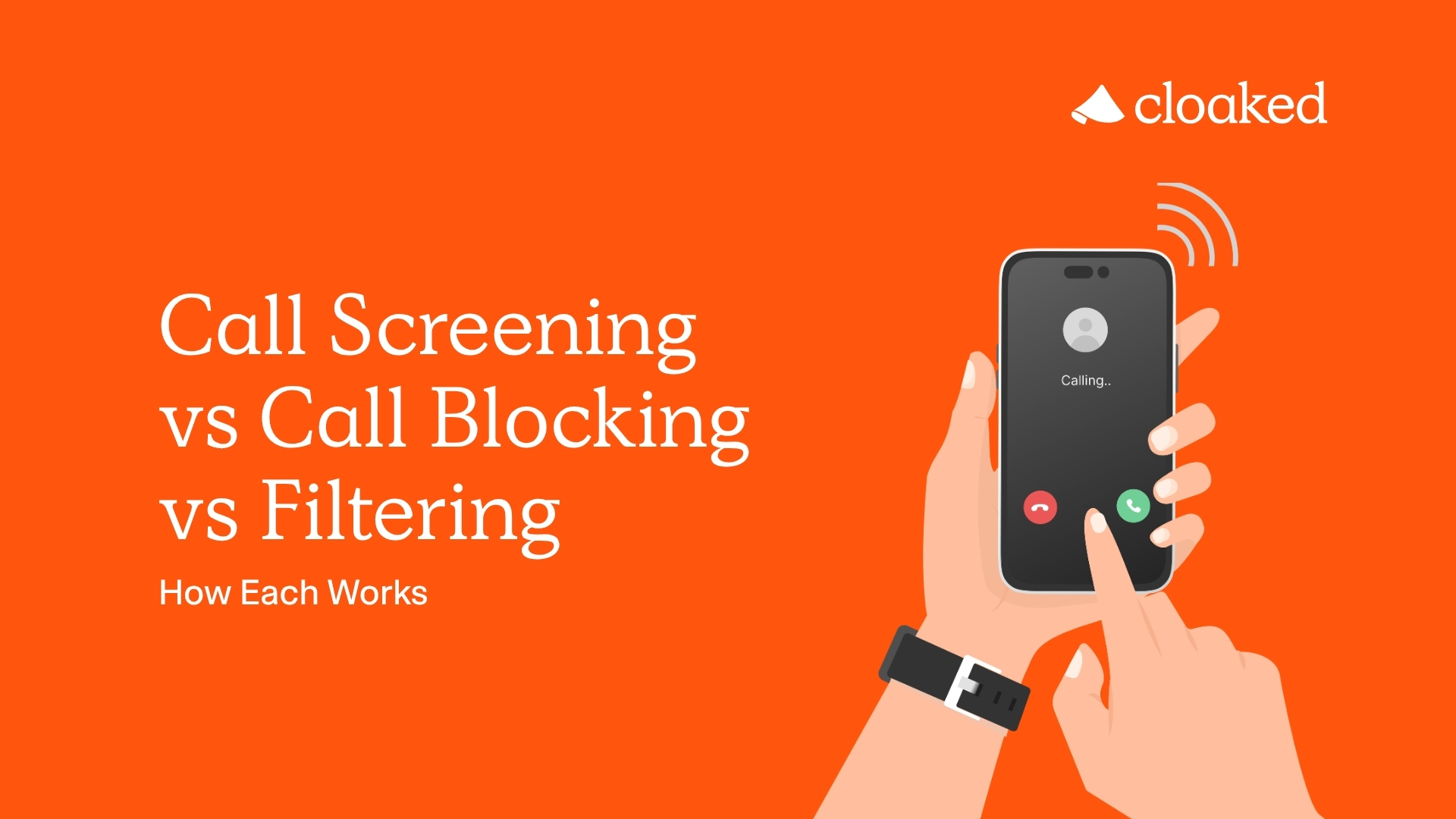
Americans received over 52.5 billion robocalls in 2025, according to the YouMail Robocall Index. Unwanted telemarketing and scam calls alone jumped 15.6% year over year, hitting 29.6 billion. The FTC's Do Not Call Registry helps reduce calls from legitimate telemarketers, but illegal robocallers and scammers largely disregard it. You've probably tried at least one spam call protection method already, whether that's silencing unknown callers or downloading an app. But most people don't know that the three main approaches to stopping spam calls (call screening, call blocking, and call filtering) work in completely different ways and catch completely different types of threats.
Knowing the difference between call screening vs call blocking matters because picking the wrong method means the wrong calls get through, and the right ones don't. Here's a plain breakdown of all three so you can pick what actually works for you.
What Is Call Screening and How Does It Work?
Call screening is the process of evaluating an incoming call before you pick up. A screening tool shows you who is calling and why, sometimes with a live transcript, so you can decide whether to answer, send the call to voicemail, or block the number. Of the three methods, screening gives you the most control.
The Basics of Call Screening
At its simplest, call screening is just Caller ID (you see a name or number and decide whether to pick up). Modern call screening tools go much further. On-device AI answers the call for you, asks the caller why they're reaching out, and shows you a real-time transcript. You can then choose to pick up, send the call to voicemail, or block the number entirely.
How AI Call Screening Works in Practice
Google Pixel's Call Screen feature and Samsung's Bixby Text Call both use AI call screening to engage unknown callers with a voice prompt. On Pixel, Google Assistant answers and asks the caller to state their name and reason for calling. You see the live transcript on your screen and decide from there whether to pick up, respond, or let it go. Samsung's newer Galaxy S26 lineup also introduced automatic Call Screening under its Call Assist menu, which works similarly. Cloaked's Call Guard takes a similar approach but adds identity masking, keeping your real phone number hidden from callers entirely.
Who Call Screening Works Best For
Call screening is ideal if you get a mix of unknown calls that could be legitimate, like calls from a doctor's office, a delivery driver, or a new contact. Screening lets the important ones through while giving you a chance to dodge spam without missing anything real.
What Is Call Blocking and How Does It Work?
Call blocking prevents specific phone numbers from ringing your phone at all. When you block a number manually or an app blocks it automatically, the call goes to voicemail, plays a disconnected tone, or gets dropped. Unlike screening, blocking is a permanent action, and you don't see the call or get a chance to decide whether it was worth answering.
How Call Blocking Apps Operate
Most call blocking apps, like Robokiller, Hiya, and Truecaller, maintain large databases of known spam and scam numbers. When a call comes in, the app checks the incoming number against that database. If the number matches a known spam entry, the call gets rejected before your phone ever rings.
You can also manually block specific numbers through your phone's built-in settings. Any number you add to your block list is permanently silenced until you remove it.
Where Call Blocking Falls Short
Call blocking works well for numbers that are already flagged. The problem is that scammers rotate through new numbers constantly. A number that was flagged yesterday may not be the one calling you today. Spoofed numbers (where a scammer makes a call appear to come from a local or familiar number) slip right past database lookups. Since blocking relies on matching a number to a known list, brand-new scam numbers get through until enough people report them. And as long as your real number sits on people-search sites and data broker databases, new scammers will keep finding it.
Who Call Blocking Works Best For
Call blocking is a good fit if you're getting repeat calls from specific numbers you never want to hear from again, like persistent telemarketers or known scam operations. Pairing a spam call screening service with manual blocking gives you stronger coverage than either one alone.
What Is Call Filtering and How Does It Work?
Call filtering happens at the carrier level, before a call ever reaches your phone or any app on it. Carriers like AT&T, T-Mobile, and Verizon use a technology called STIR/SHAKEN to verify whether a caller is who they claim to be. The FCC requires major carriers to implement these protocols as part of a broader effort to reduce illegal robocalls.
How Carrier-Level Call Filtering Works
STIR/SHAKEN is a set of FCC-mandated protocols that attach a digital signature to calls. When a call is placed, the originating carrier assigns one of three trust levels:
- Full attestation (A): The carrier has verified the caller and confirmed they are authorized to use that number.
- Partial attestation (B): The carrier knows the caller but can't fully confirm the number is authorized.
- Gateway attestation (C): The carrier only knows where the call entered the network.
The receiving carrier checks that signature and decides how to handle the call. Calls with low or no attestation may get labeled "Scam Likely" or "Spam Risk" on your Caller ID, or may be blocked outright.
Carrier-Specific Filtering Services
AT&T ActiveArmor, T-Mobile Scam Shield, and Verizon Call Filter are the carrier-branded versions of this filtering. Each one uses STIR/SHAKEN data combined with the carrier's own analytics to flag or block suspicious calls. Basic versions are usually free, while premium tiers add features like caller name lookup and personal block lists.
Where Call Filtering Falls Short
According to a 2026 TNS Robocall Investigation Report, 85% of call traffic between major carriers was signed and verified with STIR/SHAKEN in 2025, but only 17.5% of traffic between smaller carriers had the same protection. Scammers exploit these gaps by routing calls through smaller, less compliant carriers. STIR/SHAKEN also can't detect AI voice scams or social engineering once a call connects, because filtering only verifies the number, not the caller's intent or the content of the conversation.
Side-by-Side Comparison: Screening vs Blocking vs Filtering
Which Method Should You Actually Use?
No single method catches everything, and the strongest setup layers all three together. Carrier-level call filtering stops the most obvious spoofed robocalls before they reach you, a call screening tool handles the unknown callers that slip through, and manual blocking takes care of any repeat offenders.
One thing most people overlook is the privacy cost of many call screening apps and call blocking apps. Several popular apps require access to your full contact list and call history in order to function. That data often ends up on third-party servers, where it can be shared, sold, or breached. When choosing any spam call protection tool, check whether the app requires uploading your contacts before you install it.
How Cloaked Helps You Stop Spam Calls Without Exposing Your Number
Cloaked takes a different approach to the spam call problem. Instead of only filtering or blocking calls after scammers already have your number, Cloaked keeps your real phone number hidden from the start. You can generate unique phone aliases for every account and service, so your actual number is far less likely to end up on spam lists or data broker sites. Cloaked's Call Guard screens incoming calls on your behalf, and if an alias starts getting spam, you disable it and create a new one. Pair that with dark web monitoring, data removal from 130+ broker sites, and identity theft insurance up to $1M, and you cut off the pipeline that feeds robocallers your information in the first place.
Start a safety scan to see how exposed your phone number already is, or get in touch to learn more.
FAQs
What is the difference between call screening and call blocking?
Call screening shows you information about an incoming caller and lets you decide what to do with it, whether that's picking up, sending it to voicemail, or blocking the number. Call blocking automatically prevents a specific number from ringing your phone at all. Screening gives you a choice in real time, while blocking is a permanent action against a known number.
How does call screening work on Android and iPhone?
On Android, Google Pixel phones have a built-in Call Screen feature that uses AI to ask callers to identify themselves. Samsung Galaxy phones offer Bixby Text Call and, on newer models, automatic Call Screening for a similar function. On iPhone, the Live Voicemail feature transcribes voicemails in real time so you can see what a caller wants before deciding to pick up. Both platforms also let you silence unknown callers entirely.
Does STIR/SHAKEN stop all robocalls?
No. STIR/SHAKEN verifies whether the calling number is authorized, but it doesn't evaluate the content or intent of the call. Scammers who use properly registered numbers or route calls through non-compliant smaller carriers can still reach you. STIR/SHAKEN is one layer of defense, not a complete solution.
Are call blocking apps safe to use?
Many popular call blocking apps require access to your full contact list, call log, and sometimes location data to function. That information is often uploaded to third-party servers. Before installing any app, read its privacy policy and check what data permissions it requests. Some apps are transparent about data use, while others aren't.
Can AI-generated voice scams get past call filtering?
Yes. Carrier-level call filtering checks whether the calling number is legitimate, but once the call connects, filtering can't analyze the conversation. AI-generated voice scams (where a caller uses cloned audio to impersonate someone you know) rely on social engineering after the call is answered. A screening tool that engages the caller before connecting you offers better protection against this type of threat.
What is the best way to stop spam calls completely?
A layered approach works best. Start by enabling your carrier's built-in filtering service for baseline protection, then add a screening tool that evaluates unknown callers before they reach you. Manually block any repeat offenders, and if possible, use a phone number alias for signups and accounts so your real number stays off spam lists and data broker databases entirely.