




You probably know that apps collect data about you. What you may not know is how many people are fighting back and how. A new Cloaked survey of 1,009 U.S. adults reveals that nearly one in three Americans have given an AI platform a fake name or fake birthday when asked for personal information. More than half have opted out of data collection, tracking, or targeted ads entirely. And nearly all of them keep using the same apps anyway.
That is the tension at the heart of this report. Americans do not trust AI platforms with their personal data. They feel monitored, powerless, and resigned. But they have not logged off. Instead, they are quietly pushing back in small ways, lying about who they are, opting out where they can, and covering their cameras just in case. This report examines what Americans are most afraid of sharing, which AI scenarios feel the most invasive, and what it would actually take to earn their trust.
Key Takeaways
- Fewer than 1 in 5 of Americans (18%) say they trust AI to keep their personal data secure.
- Americans are most uncomfortable sharing their Social Security number (88%), financial information (87%), and biometric data (74%) with AI.
- Over 2 in 5 Americans (41%) say they would leave a platform if they shared data with government agencies.
- Over 3 in 5 Americans (64%) believe AI is making decisions about them without their knowledge or consent.
- Nearly 1 in 2 Americans (44%) say they would pay more for a service that guaranteed their personal data would never be processed by AI.
Trust, Transparency, and the Price of Privacy
Americans are increasingly aware of how their personal data is collected and used, and many feel they have less control over it than in the past. The findings below highlight how attitudes toward privacy, trust, and data sharing are shifting as new technology emerges.
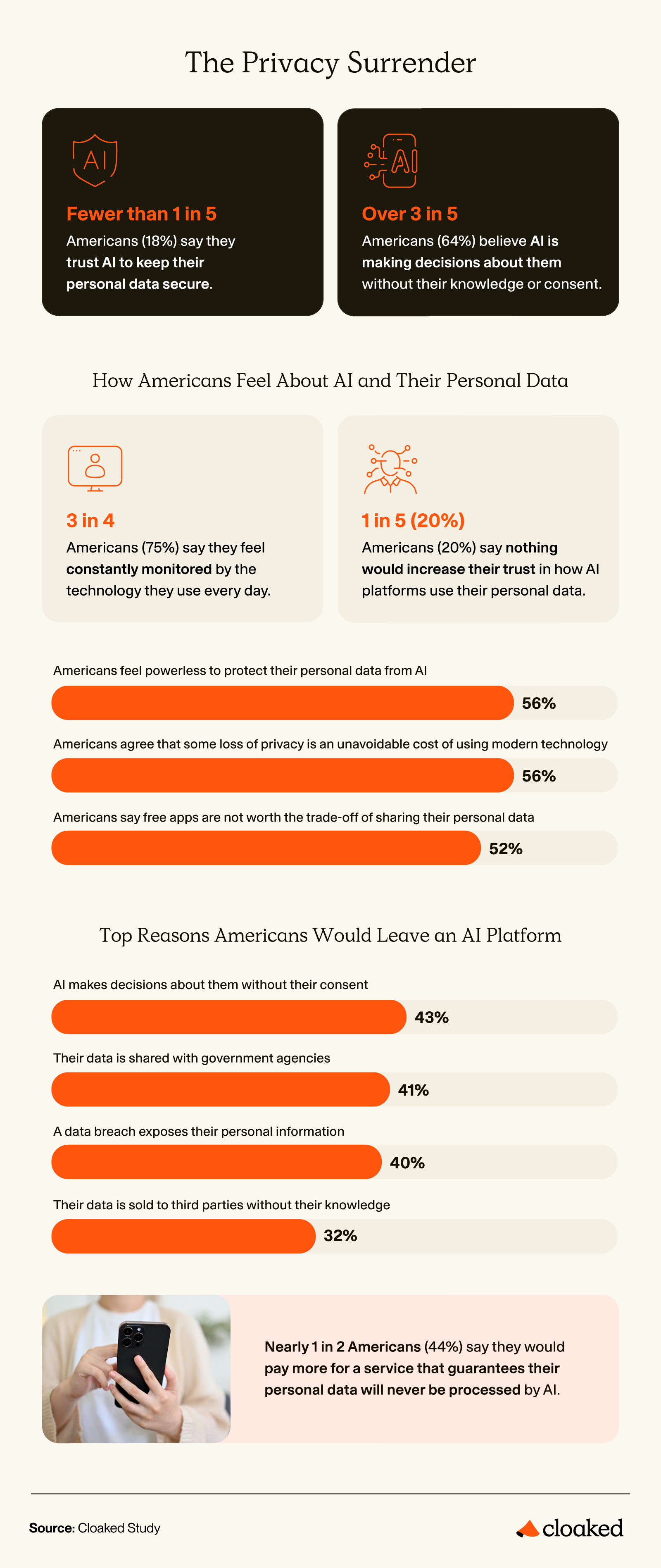
- Nearly 2 in 3 Americans say they have less control over their personal data today than five years ago.
- More than 1 in 2 Americans say they have accepted that companies know more about them than they are comfortable with.
- Boomers are the most likely of any generation to believe some loss of privacy is an unavoidable cost of modern technology (65%), compared to 54% of Gen Z.
- Gen Z is the most likely generation to feel powerless to protect their personal data from AI (59%), compared to 45% of Boomers.
- Nearly 1 in 2 Gen Z Americans (49%) say they would pay more for a service that guaranteed their data would never be processed by AI, compared to 37% of Boomers.
- More than 2 in 5 Americans said learning that AI was making decisions about them regarding credit, hiring, or insurance without their consent would cause them to leave a platform; it is the single most cited dealbreaker among those tested.
- Boomers are the most likely generation to say they would leave a platform if their data was shared with government agencies (51%), compared to 37% of Gen Z.
- While 52% of Americans feel comfortable with AI detecting fraudulent transactions, 59% feel uncomfortable with AI scanning their emails to personalize ads.
- Nearly 2 in 5 Americans are more concerned about AI collecting their children's data than their own.
Resistance, Evasion, and the Data Americans Refuse to Share
As AI tools become more integrated into everyday life, many Americans are drawing clear boundaries around what data they are willing to share. These findings reveal the situations that feel most invasive and the actions people are taking to protect their privacy.
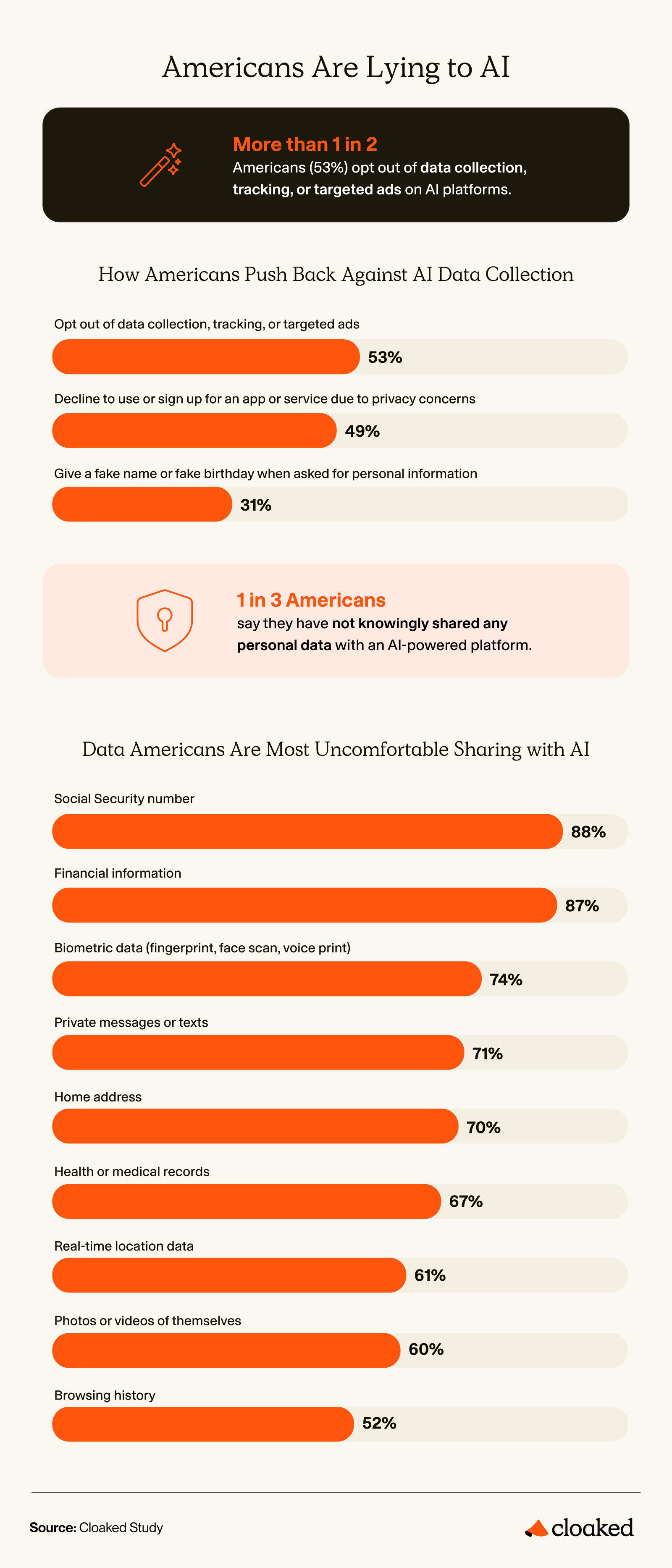
- Nearly 3 in 4 Americans say a bank reviewing their social media posts to determine creditworthiness feels creepy or invasive, with Boomers being the most alarmed of any generation (82%).
- More than 2 in 3 Americans (70%) say an app that listens to their conversations to recommend products feels creepy.
- Gen Z is more likely than any other generation to say their trust in AI platforms have decreased in the past year (28%), compared to just 11% of Boomers.
- More than 1 in 2 Gen Z Americans (55%) feel uncomfortable sharing biometric data with AI platforms, compared to 42% of Millennials.
- Women are more likely than men to have physically covered or disabled a camera on a device due to AI privacy concerns (43% vs. 34%).
- Gen X is more likely than any other generation to have deleted an account or app over AI privacy concerns (56%), compared to 42% of Millennials and 43% of Gen Z.
- Meta AI users are the most comfortable of any group with AI handling their personal data (67%) and the most likely to trust AI to keep their data secure (36%)—nearly double the rate of ChatGPT users (20%).
Below are the AI tool users most comfortable with AI handling their personal data:
- Meta AI users are the most comfortable with AI handling their personal data (67%).
- Claude users are the second most comfortable (63%).
- Grok users are the third most comfortable (62%).
Below are the AI tool users most likely to trust AI to keep their personal data secure:
- Meta AI users are the most likely to trust AI to keep their personal data secure (36%).
- Perplexity users are the second most likely (31%).
- Grok users are the third most likely (27%).
Taking Back Control
Americans are not indifferent to what AI platforms are doing with their data. They are frustrated, resigned, and quietly fighting back in whatever ways they can, lying about who they are, opting out where it is offered, covering their cameras, and continuing to use the same apps anyway because not using them no longer feels like a realistic option.
The data from this survey does not describe a public that has made peace with the current state of AI and personal privacy. It describes a public that has run out of better options. But surrender is not the only path forward. Tools exist today that let you use the internet, sign up for services, and engage with AI-powered platforms without handing over your real name, your real phone number, or your real email address. Learn more about how Cloaked can help you take back control of your personal data at cloaked.com.
Methodology
A survey of 1,009 U.S. adults was conducted on behalf of Cloaked. Respondents were asked about their comfort levels with sharing personal data with AI-powered platforms, their trust in AI companies, actions taken in response to AI privacy concerns, and which AI-related scenarios they found most alarming. The generational breakdown was Gen Z (17%), Millennials (52%), Gen X (23%), and Baby Boomers (7%).
About Cloaked
At Cloaked, we believe your data should be yours. We empower people to own their data, enabling smarter AI and apps without compromising privacy and safety. Whether you want to remove your personal information from data broker sites, create secure aliases for every sign-up, or monitor the dark web for your exposed data, Cloaked gives you the tools to take back control.
Fair Use Statement
If you would like to share or reference this report for noncommercial purposes, please link back to Cloaked and include proper credit.



