



Spam calls and texts have become a daily annoyance for most Americans, but the damage goes far beyond irritation. Cloaked surveyed 1,000 Americans to understand how robocall fatigue is changing behavior, and whether people would be willing to hand over personal data if it meant fewer unwanted calls and texts.
Key Takeaways
- Americans receive an average of 16 spam calls and 9 spam texts per month.
- 2 in 3 Americans (66%) have missed an important call because they screen unknown numbers.
- A third of Americans have missed a call from a doctor, hospital, or healthcare provider due to spam avoidance.
- Phishing emails, not robocalls, are the spam format Americans find most convincing and most likely to accidentally engage with.
- More than half of Americans (55%) refuse to share their real phone number on social media due to spam.
The Cybercrime Surge
Spam and scam calls don't exist in a vacuum. They're part of a much larger and rapidly growing wave of digital fraud that has been building for more than two decades.
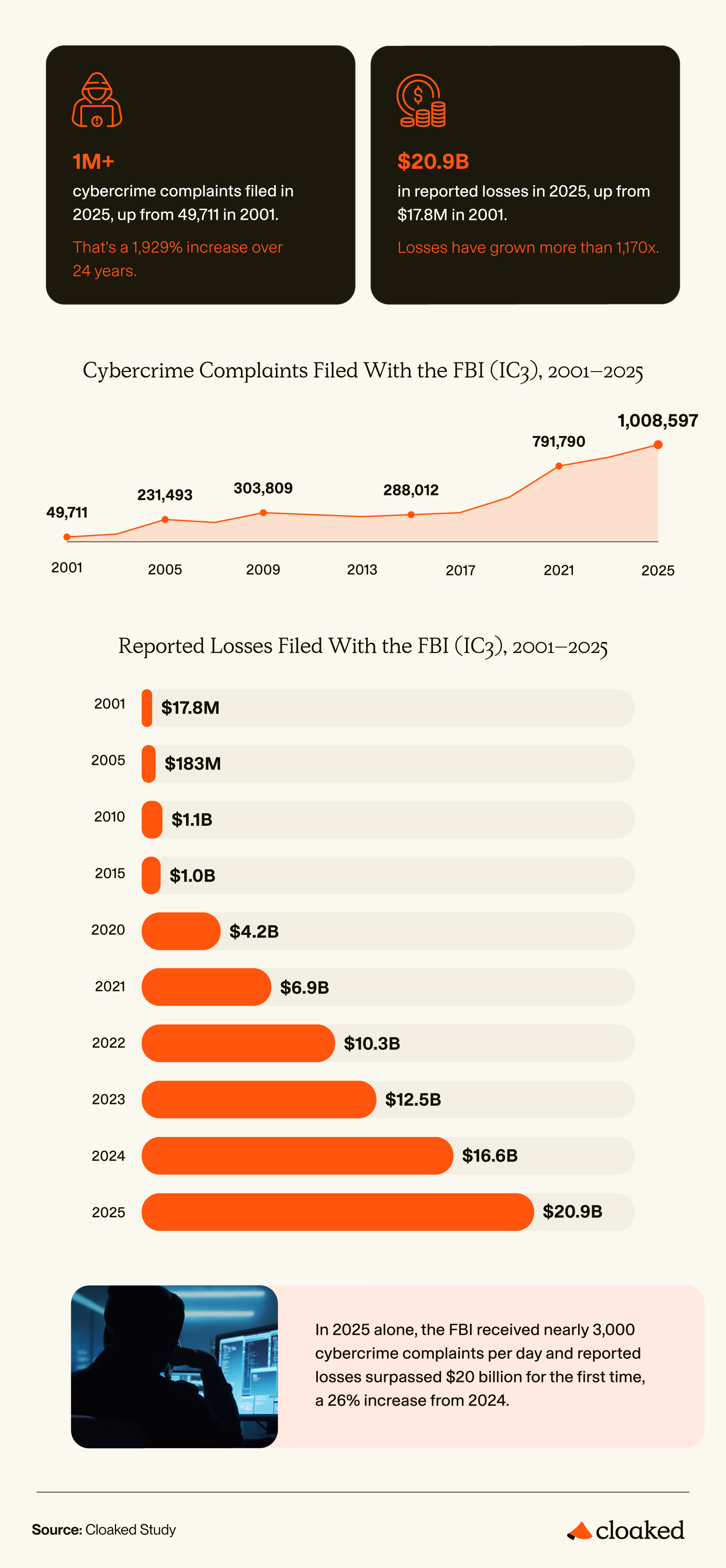
The FBI's Internet Crime Complaint Center (IC3) received 1,008,597 cybercrime complaints in 2025, up from just 49,711 in 2001, a 1,929% increase over 24 years.
Reported losses surpassed $20 billion for the first time in 2025, a 26% increase from 2024's $16.6 billion and more than 1,170 times the $17.8 million reported in 2001. Americans now file nearly 3,000 cybercrime complaints with the FBI every single day.
The Spam Epidemic by the Numbers
Most people know spam calls are out of control, but the numbers reveal just how deeply unwanted contact has changed the way Americans relate to their own phones.
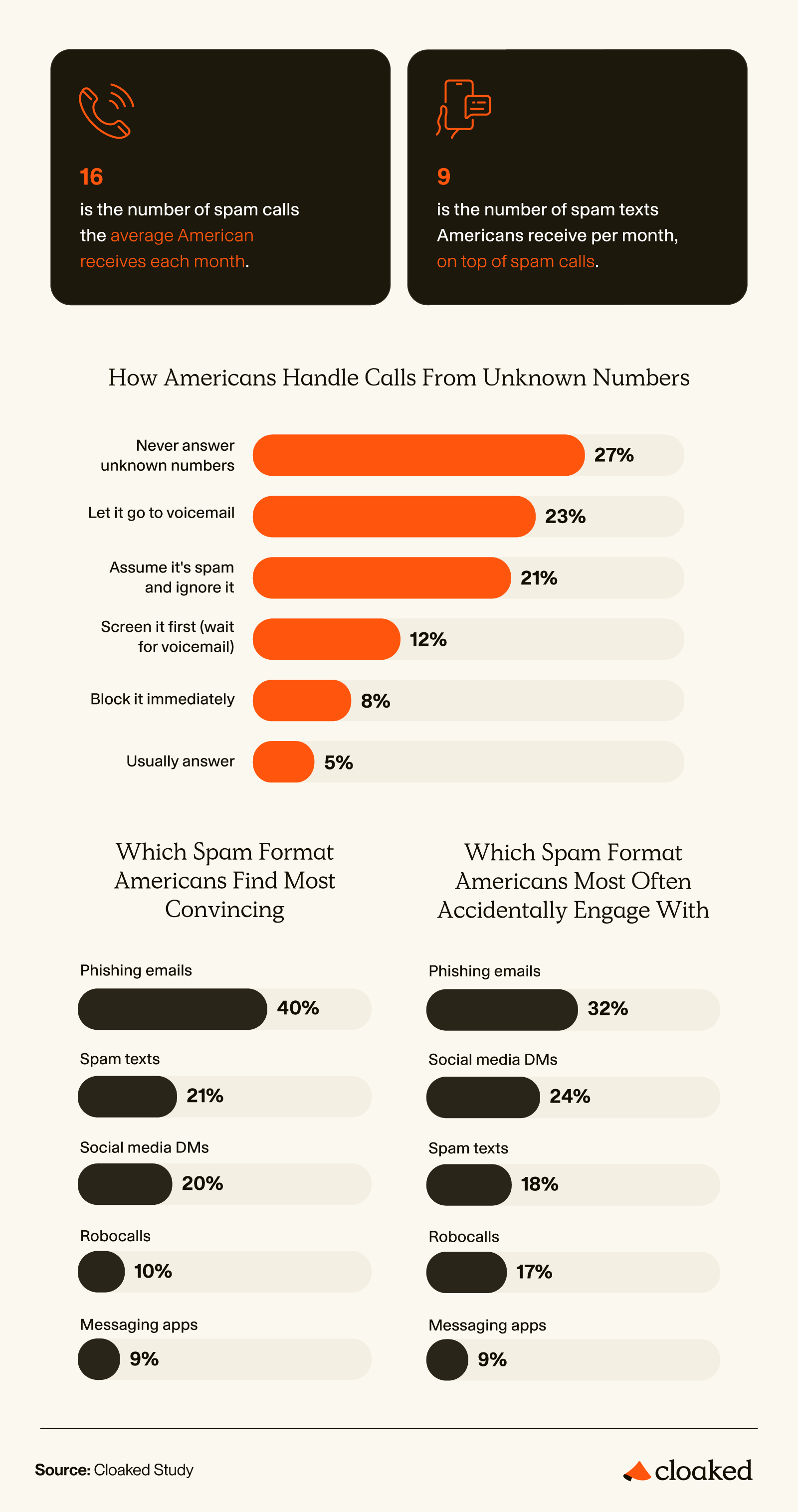
The average American receives 16 spam calls and 9 spam texts per month. Robocalls ranked as the most bothersome type of unwanted contact, with 58% of respondents naming them as their top frustration, followed by spam texts (20%) and phishing emails (14%). Despite the annoyance factor, robocalls ranked near the bottom among formats people find convincing.
Phishing emails pose a bigger threat than robocalls do. They ranked first as the most convincing format (40%) and first as the format most likely to cause accidental engagement (32%). Social media DMs ranked second for accidental engagement at 24%, while spam texts ranked third at 18%. Robocalls, for all their irritation, only prompted accidental engagement from 17% of Americans.
More than a quarter of Americans (27%) said they never answer calls from unknown numbers. Another 23% let these calls go to voicemail, and 21% assume any unknown call is spam and completely ignore it. Altogether, around 8 in 10 Americans rarely or never answer calls or texts from numbers they don't recognize.
The Privacy Tax: What Americans Will Trade for Silence
Spam fatigue isn't just an annoyance. It's changing how Americans go about their daily lives, from which calls they answer to where they're willing to share their contact information.
.png)
Two-thirds of Americans (66%) have missed an important call because they ignored or screened out an unknown number, and a third (33%) have missed a call from a doctor, hospital, or healthcare provider as a result. Other commonly missed callers included:
- Employers or recruiters (18%)
- Pharmacies or insurance providers (16%)
- Financial institutions (15%)
The instinct to withhold a phone number is common in many situations. More than half of Americans (55%) said they refuse to give out their real number on social media. Others refuse to do so while online shopping (33%), on a dating app (30%), or when signing up for a rewards program (26%). Even professional platforms like LinkedIn prompted phone number avoidance from nearly 1 in 4 respondents (24%).
When it comes to self-protection, phone carrier tools lead the pack. More than half of respondents (53%) had enabled their carrier's spam filtering feature, while 43% said they avoid giving their real number online, and 41% had registered on the Do Not Call Registry.
Would Americans Trade Privacy for a Meaningful Drop in Spam?
The FCC has pushed for stricter identity verification requirements for phone carriers, but getting Americans to actually hand over that data is a different challenge entirely.
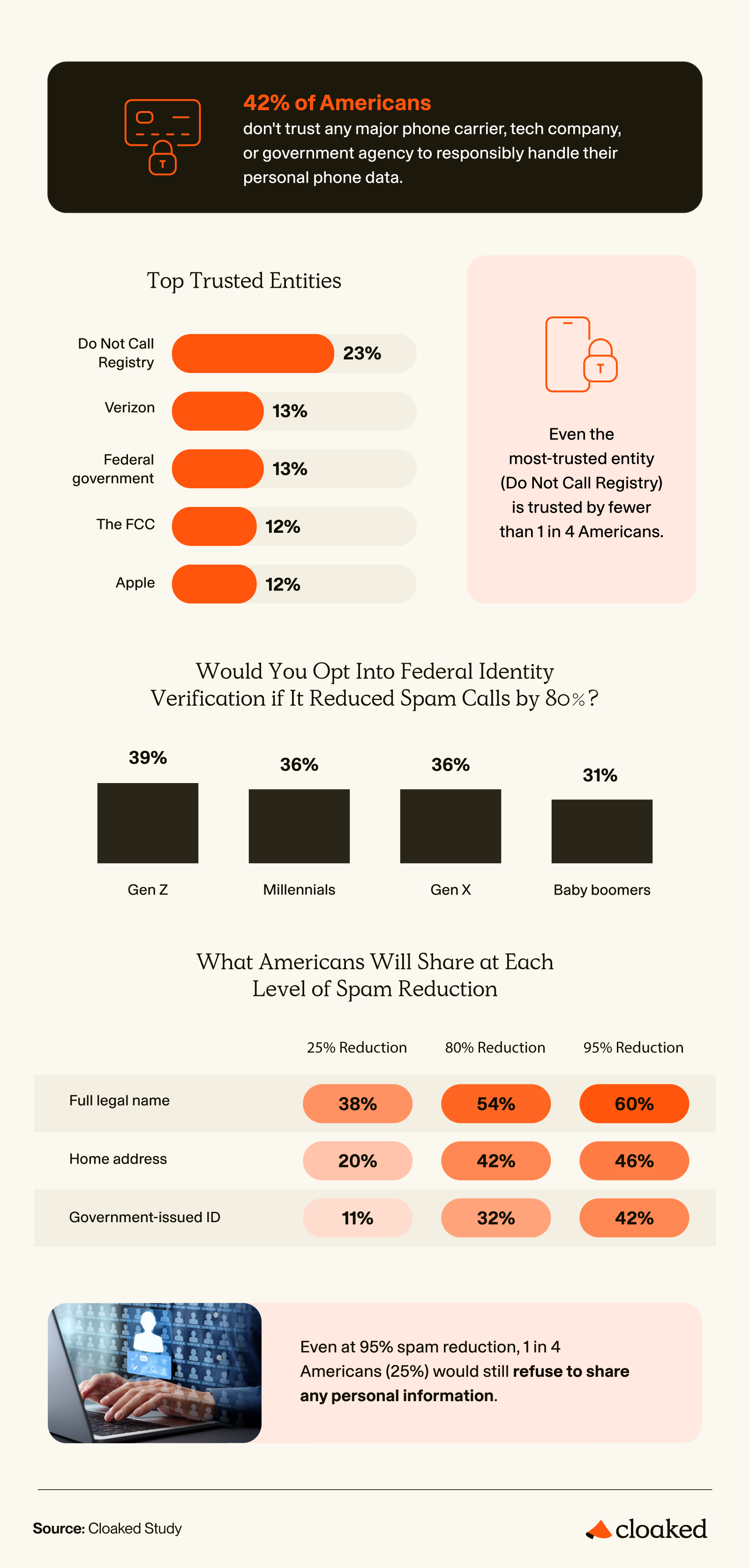
When given a list of 15 major carriers, tech companies, and government agencies, 42% of Americans said they trust none of them to responsibly handle their personal phone data.
Fewer than 1 in 4 Americans selected the Do Not Call Registry, the most trusted entity, with carriers, tech companies, and government agencies trailing behind:
- Do Not Call Registry (23%)
- Verizon (13%)
- Federal government (13%)
- FCC (12%)
- Apple (12%)
Baby Boomers were the most likely to trust the Do Not Call Registry (40%), compared to just 21% of Gen Z. Gen Z led trust in Apple (15%) and the federal government (17%) relative to all other age groups.
Over a third of Americans (36%) said they would opt into a system requiring their carrier to share their ID with a federal database in exchange for an 80% reduction in spam calls. Gen Z was the most willing generation to make that trade at 39%, while baby boomers were the most resistant, with 33% saying no outright.
Even when the promised reduction climbed to 95%, 1 in 4 Americans said they still wouldn't share any personal information. For a significant portion of the population, no amount of spam relief is worth surrendering their identity data.
Your Phone Number Is Worth Protecting
Spam calls and texts have become so pervasive that millions of Americans have restructured how they use their phones by screening every unfamiliar number, withholding their contact information, and missing calls that actually matter. We found that people are willing to change their behavior to protect themselves, but they're far less willing to hand their identity over to someone else to do it for them. Taking control of what you share and with whom is one of the most practical steps you can take to protect your personal information online.
Methodology
Cloaked surveyed 1,000 Americans in June 2026 about their experiences with spam and the sharing of personal information. Respondents were screened for approval status and deduplicated to ensure one response per participant. The sample included men (41%), women (57%), and non-binary respondents (1%), and spanned four generations: Gen Z (16%), millennials (48%), Gen X (25%), and baby boomers (10%).
For questions asking respondents to estimate a numeric value, averages were calculated using the interquartile range (IQR) method to minimize the effect of outliers. Questions that allow multiple selections were included; percentages for those questions are based on the total number of respondents and will not sum to 100%. Percentages throughout may not sum to 100% due to rounding.
Cybercrime complaint and loss data referenced in The Cybercrime Surge section was sourced from the FBI's Internet Crime Complaint Center (IC3) 2025 Annual Report, published by the Federal Bureau of Investigation. This data reflects complaints submitted directly to IC3 by the public and represents reported figures only; actual cybercrime losses may be higher due to underreporting.
About Cloaked
At Cloaked, we empower people to own their data, enabling smarter AI and apps without compromising privacy and safety.
Fair Use Statement
The data and findings in this article may be used for noncommercial purposes only. Any reproduction or reference to this content must include a link with proper attribution to Cloaked.



