Your Digital First Impression: What Does a Quick Search Reveal About You?
When someone searches your name, what shows up can shape their opinion before you ever meet. Today, that first impression can come from Google results, people-search sites, social media profiles, and even AI tools that make personal details easier to surface.
To understand how exposed Americans really are, Cloaked surveyed 1,057 U.S. adults and analyzed Google search volume trends from January 2024 to February 2026 across 125 digital identity and online privacy terms. The results revealed a growing gap between how much control people thought they had over their online presence and what their digital footprint actually said about them.
Key Takeaways
More than 2 in 5 Americans (43%) appear on the first page of Google results when they search their own name, and more than 1 in 3 of those who feel confident about their results (38%) didn't even show up on page one.
- Over 1 in 3 Americans (34%) lose interest in someone after looking them up online, but only 1 in 5 Americans (20%) suspect it has happened to them.
- Nearly 1 in 4 dating app users (22%) use an AI tool to research someone before a first date.
- Nearly 1 in 2 Americans (47%) have no idea they could search themselves on AI tools like ChatGPT or Gemini.
- Over 1 in 2 Americans (53%) who try to remove personal information from the internet fail or have only mixed results.
- Combined search volume for AI-related privacy terms grew 165% year over year.
Privacy Awareness Is Rising, but Mostly Before Something Goes Wrong
More people are actively thinking about their digital footprint, especially as AI makes personal information feel easier to surface. Search behavior suggests that concern around online privacy is growing quickly, even if most people are still focused on prevention instead of cleanup.

Combined search volume for AI-related privacy terms grew 165% year over year, showing a sharp increase in public interest around digital identity and personal data exposure. Searches for "remove personal information from the internet free" more than doubled year over year, rising 133%, while "how to delete personal information from the internet" grew 34% and remained the highest-volume removal term.
Nearly all digital identity searches (96%) focused on awareness, monitoring, or protection, while only 3% were reactive and tied to deletion, removal, or damage control. That pattern suggests people are trying to stay ahead of exposure, not just respond after the fact.
Some search terms point to more urgent privacy concerns. Searches tied to doxing prevention grew 37% year over year, while arrest record removal searches rose 72%. Many people were worried about visibility, but also about serious reputational or safety risks connected to identity theft and public exposure.
Search activity also varied widely by state. New Hampshire led the nation in per capita digital identity searches with 13,396 per 100,000 people, nearly double Hawaii's 6,901. The Northeast dominated the top 10 per capita rankings, with 8 of the 10 most active states located in the region. Vermont, Wyoming, and Delaware over-indexed the most for urgent or reactive searches, each landing at roughly double the national average for removal, deletion, and damage-control terms.
What People Found Online Often Did Not Match How in Control They Felt
Seeing yourself online is one thing. Feeling confident that your search results are accurate, current, and limited to what you want others to see is something else entirely.

About 2 in 5 Americans appeared on the first page of their own Google results, but visibility varied by generation. Millennials were the most likely to show up on page one at 49%, while Gen Z (38%) and baby boomers (37%) were less likely. At the same time, 14% of Americans had no idea what would appear first if someone searched their name, showing that many people aren't fully aware of their digital first impression.
Control over that impression felt limited:
- Over 3 in 5 Gen X Americans (62%) disagreed that they felt in control of what appears about them online, and 49% of Gen Z Americans did as well.
- More than half of women (57%) and 44% of men agreed their personal information was more publicly available than it should be.
The findings also showed major gaps in awareness. Nearly 1 in 5 Gen Z Americans (17%) had no idea their information may already be listed on people-search sites, compared to just 5% of millennials. About 1 in 2 Gen X Americans did not know they could search themselves on AI tools, the highest rate of any generation.
When people looked themselves up, many found reason for concern. Half of Americans who searched for their own personal details said that information was easy to locate, and more than 1 in 2 baby boomers said their Google results contained outdated or irrelevant information. Women were also slightly more likely than men to report at least one negative consequence from having personal information online (74% vs. 70%).
For active job seekers, those risks felt even more immediate. Nearly 1 in 3 found something about themselves online that they did not want others to see, compared to about 1 in 5 non-seekers. That gap suggests digital reputation matters most when you feel like you are being evaluated.
Search Results Are Quietly Influencing Dating Decisions
Looking someone up before meeting them has become common behavior, especially for people using dating apps. What surfaces online often shapes interest, trust, and how willing someone feels to move forward.

More than 4 in 5 dating app users (84%) checked someone's social media before a first date, far higher than the 1 in 2 non-dating app users who did the same. Nearly 1 in 4 dating app users (22%) also used an AI tool to research someone before a first date, while only 6% of non-dating app users did so.
Women were more likely than men to research someone before meeting. Nearly 1 in 2 women (49%) Googled someone before a first date, compared to nearly 2 in 5 men (37%). Women were also more likely to lose interest after looking someone up online (40% vs. 29%).
Online visibility also affected how people presented themselves. Nearly 1 in 4 dating app users (23%) held back from pursuing a romantic interest because of what others might find about them online, compared to just 7% of non-dating app users. That points to a more personal side of digital exposure: people were judging others and also second-guessing themselves.
A quick search no longer stops at dating. Employers, professional contacts, and job seekers are also using online information and AI tools to decide whether to move forward.
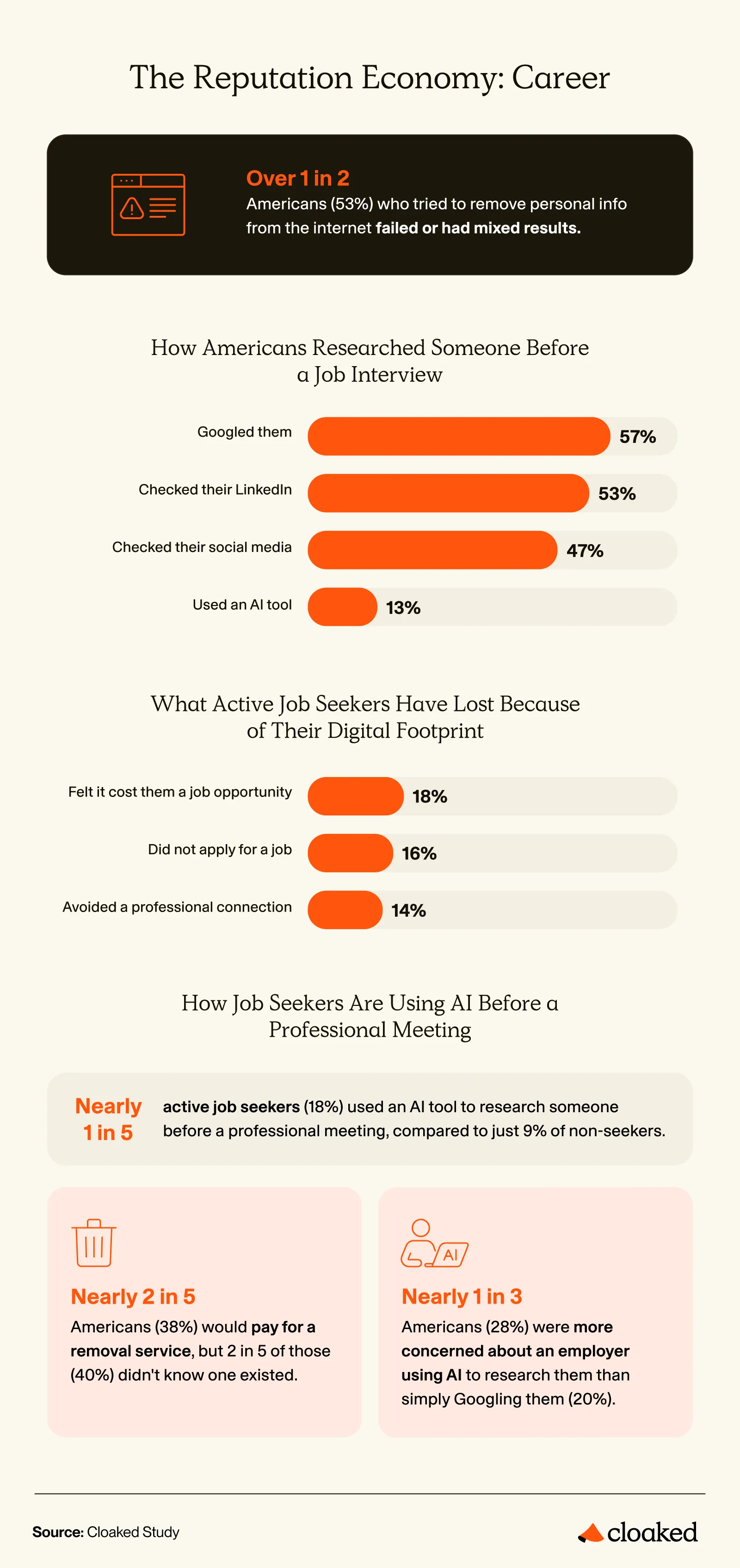
Nearly 1 in 5 active job seekers (18%) felt their digital footprint cost them a job, roughly double the rate of non-seekers. About 1 in 6 (16%) chose not to apply for a position, and about 1 in 7 (14%) avoided a professional connection entirely, each at roughly double the rate of people who were not actively job hunting.
AI was also changing how people prepared for professional interactions. Nearly 1 in 5 active job seekers (18%) used an AI tool to research someone before a professional meeting, compared to just 9% of non-seekers. That added another layer to digital first impressions, especially for people already worried that their online information was outdated, overly visible, or easy to misread.
Younger adults appeared more ready to take action. More than 1 in 3 millennials (36%) had tried removing personal information from the internet, the highest rate of any generation, compared to about 1 in 5 baby boomers (21%). Gen Z and millennials were also the most willing to pay for a data removal service, suggesting that younger Americans saw digital identity management as increasingly necessary rather than optional.
Your Search Results Are Part of Your Reputation
Your digital first impression now reaches into dating, hiring, networking, and everyday trust. The findings showed that many Americans were concerned about what others could find, but fewer fully understood how visible they were or how hard it can be to fix outdated or unwanted information once it is out there. The clearest takeaway is simple: checking what appears about you online is no longer just a privacy habit; it is part of protecting your reputation, reducing identity theft risk, and staying in control of your personal data.
Methodology
A survey of 1,057 U.S. adults was conducted on behalf of Cloaked to measure the gap between how people perceive and manage their digital identity and what the internet actually reflects back. Respondents were asked about their awareness of their online presence, their confidence in what others can find about them, their experiences with people-search sites and AI tools, consequences they have faced from their personal information being online, and how their digital footprint has affected their dating and career opportunities. The generational breakdown was Gen Z (18%), millennials (44%), Gen X (24%), and baby boomers (9%).
Additionally, we analyzed Google search volume data from January 2024 to February 2026 to identify which states searched for digital identity and online privacy terms most frequently on a per capita basis. Our analysis examined 125 related search terms across all 50 states and ranked them accordingly to highlight where awareness and concern about personal data exposure were highest.
About Cloaked
At Cloaked, we believe your data should be yours. We empower people to own their data, enabling smarter AI and apps without compromising privacy and safety. Whether you want to remove your personal information from data broker sites, create secure aliases for every sign-up, or monitor the dark web for your exposed data, Cloaked gives you the tools to take back control.
Fair Use Statement
If you would like to share or reference this report for noncommercial purposes, please link back to Cloaked and include proper credit.